
Thursday, October 22, 2026


Typically, we think of rare bird visitors to Thurston County as avian mistakes — birds that have messed up their migration instincts and landed here. Our recent historic, first-ever white-faced ibis might be a good example.
But there is another sort of visitor that arrives here from time to time — birds that are common in Eastern Washington but are unusual or rare west of the Cascades. Now that more birders are out and about with the Merlin app, which can identify unusual songs, there’s more documentation of these occasional visitors. Also, apps, websites and social media mean that a rarity may provoke an immediate reaction in our local birding community.
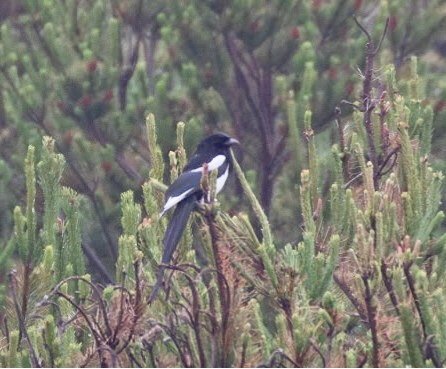
Earlier this week, a sharp-eyed birder spotted a black-billed magpie flying overhead in west Olympia. In Eastern Washington, these birds are common rural residents, regularly seen from the car as one drives along. But here, that same bird generates great excitement.
Magpies are members of the Corvid family, meaning they are related to crows and ravens and share some of the same characteristics. They are crow-sized black and white birds with long tails. In good light their backs shine an iridescent blue-green. The sexes look identical. Our Olympia bird has been seen in the company of crows and, with some luck, you might spot it.

Another predominately black bird from Eastern Washington, the yellow-headed blackbird, is occasionally seen on the edges of wetlands in our area. The male of this species is unmistakable, with a bright yellow head and breast, an all-black body and flashy white patch it his wings. The females are mostly brown, but with some yellow on their faces.
Anywhere in Thurston County where there are wetlands you are likely to find red-winged blackbirds. I often ignore them — just more blackbirds (but with what would be a best-selling song if birds ever sold their songs). In writing this week’s column, I am reminding myself that, once in a while, those blackbirds calling from cattails, in addition to our common residents, might include a visitor from the east.
A third Eastern Washington bird you might encounter in Thurston County is the western kingbird. They prefer open country and are occasionally seen in prairie and open grassland habitat. Earlier this week a pair of western kingbirds was reported from West Rocky Prairie wildlife area northwest of Tenino (see The JOLT, 4/23/26 for more information about this wildlife area).

Western kingbirds are large robin-sized members of the flycatcher family, migrating to Washington in the early spring from their wintering territories in southern Mexico. They have bright yellow bellies, a gray head and back, and white throat and breast. Their tails are black with white outer feathers that are striking as they fly off. As with all flycatchers, the sexes look alike.
These birds hunt flying insects from a prominent perch and are often seen on wires along rural roads in Eastern Washington. Although they do not have an actual song, they communicate with each other with a loud "kip" note that might help you locate them.
All three of these species are “out-in-the-open” birds and, if they’re around, you may see them just by keeping alert to birds that seem a little different.
The fourth wanderer from Eastern Washington hangs out in brushy areas.

The Nashville warbler is a fairly common breeding bird in Eastern Washington that seems to be slowly expanding its range. In recent years, it has been seen (and heard) more often west of the Cascades, including here in Thurston County. They are small birds and are often overlooked.
Male Nashville warblers have a bright yellow throat, breast and belly, gray head and olive back. When you get a good look, you also will see a white eye ring. Females are paler versions of the males. In Western Washington these warblers are often first identified by song, "see-bit, see-bit, see-bit," followed by a trill.
These birds prefer brushy wooded areas and likely will be easier to hear than to see. The Merlin app, of course, can help here. Both last year and earlier this year, my Merlin app identified a singing Nashville warbler for me here in Thurston County.
Using these clues, your binoculars and Merlin app, you may have some luck finding these, or perhaps other, Eastern Washington wanderers.
George Walter is environmental program manager at the Nisqually Indian Tribe’s natural resources department; he also has a 45+ year interest in bird watching. He may be reached at george@theJOLTnews.com
Photos for this column are provided by Liam Hutcheson, a 18-year-old Olympia area birder and avid photographer.


2 comments on this item Please log in to comment by clicking here
Porter
Awesome. I will look and listen around Capitol Lake.
Friday, May 29 Report this
CommonSenseSenior
Fantastic column, George and Liam!! I look forward to it.
Friday, May 29 Report this