
Thursday, October 22, 2026


It’s Prairie Time! Each year for three weeks centering on April 30, the native prairies of Thurston County come alive with wildflowers.
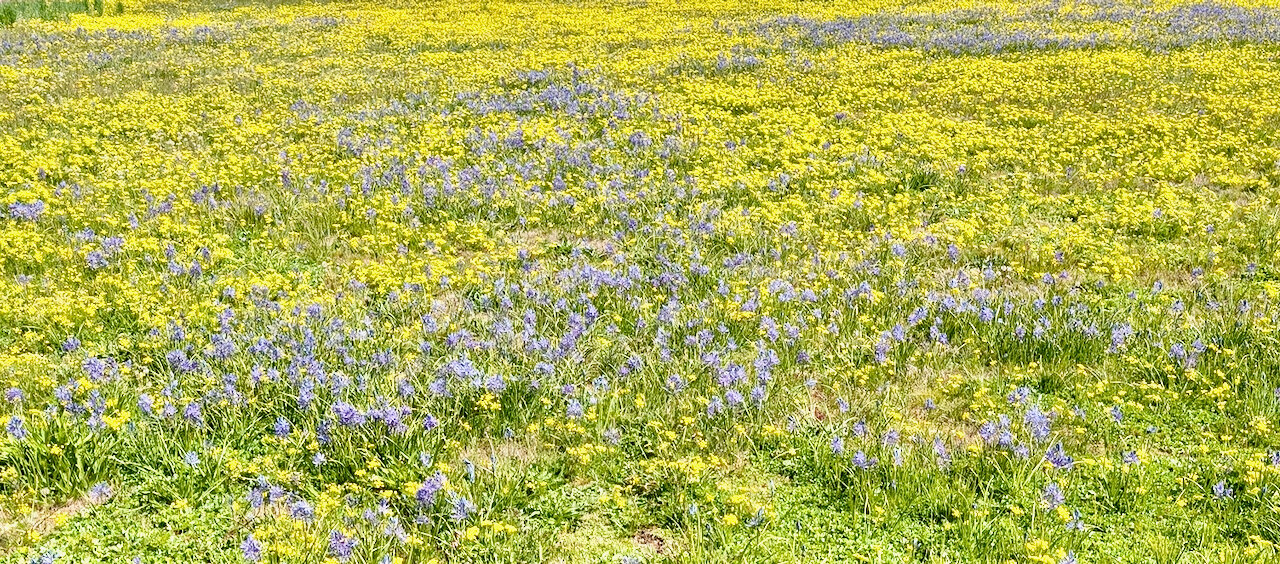
Bird watchers often visit the prairies to see the uncommon bird species that like this native habitat. But for the next few weeks such a visit has this wonderful wildflower bonus.
Our prairies are the result of an Ice Age glacier, and glaciers are not made of ice alone. As they move, they pick up rocks, grinding and rounding them as they go. You can see this action in real time by visiting Mount Rainier National Park — river channels full of rounded gravel. And, as further proof, each summer the rock dust ground up by the mountain’s glaciers makes the water in its rivers look milky.

The continental glacier was huge in comparison with the Rainier glaciers. It covered much of the land between here and northern Canada. As it advanced to the south, it changed the landscape. It gouged out Puget Sound, and elsewhere it flattened the ground, but as it reached our area some 10,000 years ago, the climate changed and its advance ended. The Bald Hills of southern Thurston County were created by the glacier’s push south, and also mark the glacier’s end (its “terminal moraine”).
The glacier’s impacts in the landscape remain dominant today. For a few centuries after warming started, the glacier made small advances, creating ridges, and then made small retreats, depositing sand and gravel next to the ridge. This landscape describes much of the southern county. Eventually, with the glacier rapidly retreating, large rivers formed, carrying an outpouring of sand and gravel deposits across much the county’s landscape.

Most of the county’s soils that developed post-glacier are thin and underlain with all that sand and gravel. As a result, rainfall quickly soaked into the ground. The prairie habitat plants, including Oregon oak trees, thrive in these thin fast-drying soils. (The porous soils, incidentally, also means that we have large and productive aquifers underlying most of Thurston County — that’s where most of our abundant rainfall goes).
Today, we still have those same rocky soils but there are only a few remnant native prairies remaining, and this is the season to visit them. They’re beautiful and, of course, such a visit reminds us that much of Thurston County pre-settlement consisted of rolling grassy prairies that, during spring, were a colorful palette of wildflowers.
There are three state wildlife areas in south Thurston County, all with access to good prairie habitat. Visiting one or several in the next three weeks would be a great spring birding trip. (Incidentally, a Washington Discover Pass is required for parking at any of the locations described in this column).
One area is Scatter Creek. I wrote about this site in the JOLT on March 12. The second is called West Rocky Prairie, located off Tilley Road south of Millersylvania State Park. The assigned parking area is along Arrowhead Lane SE about 2 miles east of Tilley Road. This 810-acre area includes Mima Mounds and a stream and wetland complex, all good bird habitat.

There’s a 1-mile access trail across a ridge, eventually reaching a narrow footbridge across Beaver Creek. A 2-mile loop road/trail circles the prairie and you can expect to see many unusual birds, including western bluebirds, Savannah sparrows, western meadowlarks and California quail. This birding area requires a commitment to hiking. Just to reach the prairie requires a 2 mile walk in and out; including the loop trail, the total 4+ miles may be too much for some visitors.

Of the birds we typically only see in prairie habitat, I particularly like the chipping sparrow. This migrating sparrow reaches our county in late March. Sexes are alike and its most obvious identification markers are its head, with a rusty red cap and black eyeline, and a plain gray breast and belly. You likely will hear multiple males singing a characteristic long, dry trill, sometimes lasting three+ seconds.
The third south-county area, and the most recently protected for public access, is the Violet Prairie Wildlife Area, located off Old Highway 99 about 2 miles west Tenino. This 1,040-acre site includes oak woodlands and prairie habitat, and a portion of it was burned in 2025 as part of prairie restoration. Rare birds reported there this spring include Oregon vesper sparrows and streaked horn larks.

Probably the single best prairie area in the county is the Thurston County Glacial Heritage Preserve. This 80-acre site, acquired in 2005, preserves some prairie landscape as it was before European immigration in the mid-1800’s. It’s usually closed to public access, but each spring the Friends of Puget Prairies hosts Prairie Appreciation Day, a chance for the public to visit. This year’s appreciation day is Saturday, May 9.
All of the prairie locations I have mentioned are not really accessible for birders with limited mobility. But the Mima Mounds Natural Area Preserve, also located in southern Thurston County, has an accessible paved trail out into a nice native prairie with abundant birds and, for these critical three weeks, wonderful blooming wildflowers. It’s also a very friendly place for children to get their first exposure to the prairies without too much stress.
George Walter is environmental program manager at the Nisqually Indian Tribe’s natural resources department; he also has a 45+ year interest in bird watching. He may be reached at george@theJOLTnews.com
Bird photos for this column are provided by Liam Hutcheson, an 18-year-old Olympia area birder and avid photographer.


3 comments on this item Please log in to comment by clicking here
pbaron1902
Congrats to young Liam Hutchesonn, fine photographer, for his wonderful photos, making it possible for all of us to enjoy their uniqueness and beauty. Thank you, Liam!
Thursday, April 23 Report this
JasonWettstein
What a beautiful and informative article :-) Appreciate this work George!
Friday, April 24 Report this
Georgewalter
Rare bird alert. There is a white-faced ibis at the Nisqually NWR. It's foraging in the grassy strips between the Twin Barns and wetland, visible from the viewing platform. Look for a duck-sized dark iridescent bird with long wadding legs and a large down-curved bill. As far as I know, this is a first for Thurston county
Saturday, April 25 Report this