
Thursday, October 1, 2026


Last Sunday was a good weather day, at least for Thurston County in December. No rain and not bitter cold, although one did not have to be walking around for long before the damp began to creep into your feet from the wet ground.
It was the day of the Olympia Christmas Bird Count (CBC), and I was walking the same areas I had walked in previous Sundays in mid-December for many years.
While drinking my wake-up coffee, I remembered a winter past when all the standing water was frozen, and the trails were crunchy rather than damp. And another count day when a young Liam Hutcheson and his mother, Elizabeth, joined me; I was impressed that Liam went birding not with binoculars, but with a long lens camera.
This year-to-year carryover is one of the things I value most about participating in Christmas Bird Counts. Each year I revisit the same places, noting both changes and consistencies in bird populations.
There are now homes built where I used to walk a wooded path, but the adjacent wetland is still intact and just as birdy as always. This same story is often retold by CBC volunteers, seeing development change the habitat from woods to lawns and bird feeders. It might be neither good nor bad, but it sure is different from years ago.
Some CBC Sundays I am on my own, but this year I was blessed with company. I say “blessed” because I learned something important this day, not about the birds — they were their usual busy selves. Rather, I learned that I can no longer hear certain bird noises anymore and that was a shock.
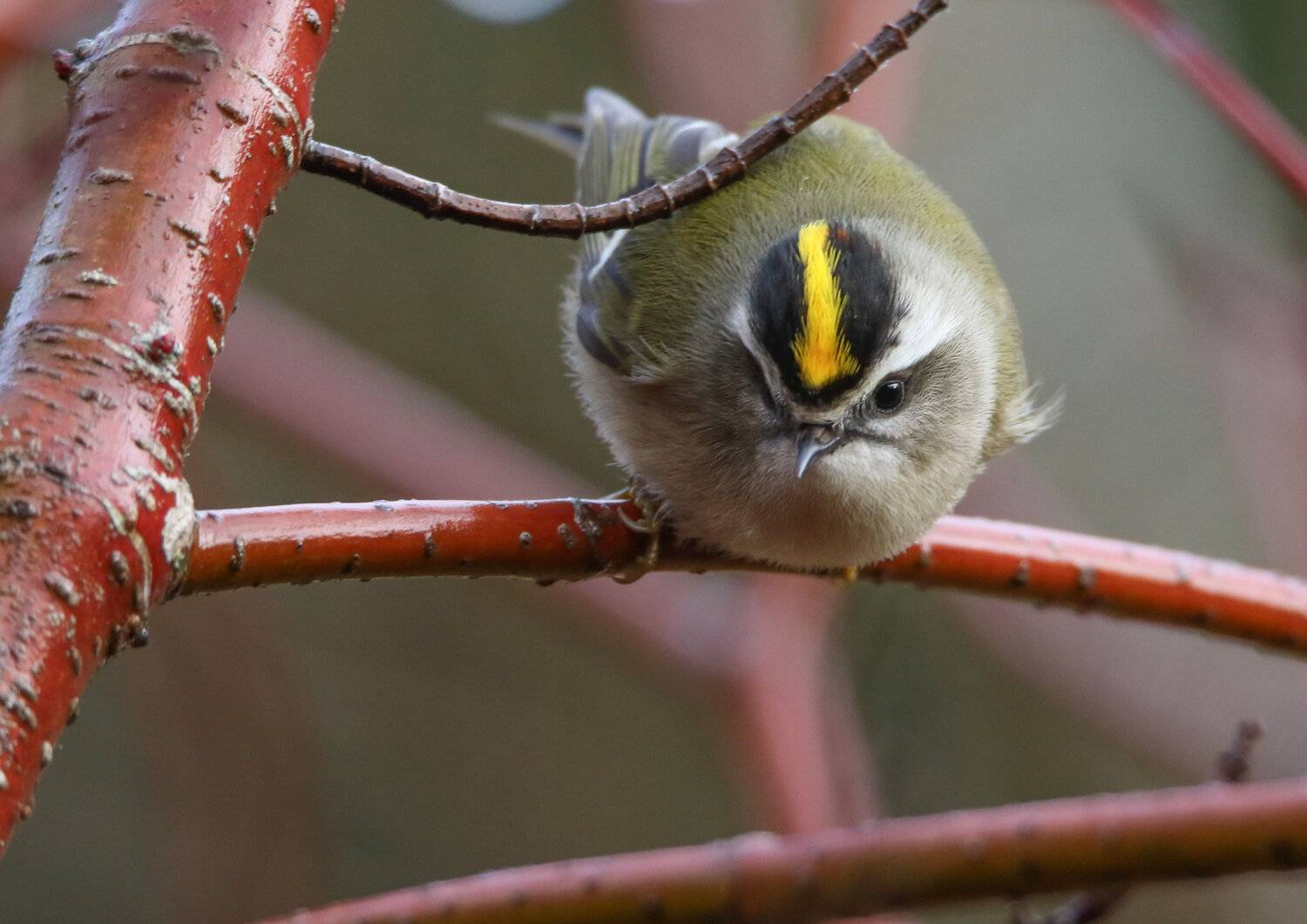 Golden-crowned Kinglet
Photo by Liam Hutcheson
Golden-crowned Kinglet
Photo by Liam Hutcheson
My longtime count area is one that still has an abundance of huge firs, hemlock, cedars and maples. In the winter, the upper branches of these huge trees provide feeding territory for several species of small birds, especially flocks of Golden-crowned Kinglets and Chestnut-backed Chickadees. My typical approach to inventory these top-of-the-tree birds is to use “pishing” to get their attention, which makes them curious enough to come down from the heights for closer inspection.
 Chestnut-backed Chickadee
Photo by Liam Hutcheson
Chestnut-backed Chickadee
Photo by Liam Hutcheson
Pishing is something worth doing if you want to see birds up close. This noise is an imitation of a general small bird alarm note. Every birder’s “pish” sounds a little different, but it doesn’t seem to bother the birds, and it is guaranteed to make them want to find out more about that weird-sounding bird.
Anyway, back to my story. I had been noticing in recent years that the kinglet flocks were not as common as they once were. As we were walking along, with me pishing from time to time, my friend asked, “Do you hear those birds?” I did not. Those soft tinkling kinglet calls, as least at a distance, are now lost to me
We stopped, of course, and I kept making my noisy alarm call. Those unheard birds soon came down from the treetops and we were surrounded by a flock of about 40. There were kinglets, chickadees and even a pair of Townsend’s Warblers. These warblers carry their breeding colors into the winter and it’s quite a treat to see their black and yellow colors flash by.
 Townsend Warbler - female
Photo by Liam Hutcheson
Townsend Warbler - female
Photo by Liam Hutcheson
The main method of the Christmas Bird Count program is to repeat the same count over many years and thus gain some perspective on trends in numbers and species composition. The totals can vary greatly from year to year, due primarily to bad weather limiting the activity of both birds and the bird counters.
Now I was learning that the numbers reported from year to year, at least by me in my area, may also have varied by my declining hearing ability. New CBC rule? All old timers with suspect hearing must be accompanied by a set of younger ears.
Overall, this year’s Olympia CBC was highly successful. Numbers are still coming, but we already know that this year’s species total was at least 130, several more than the average of 126. In poor weather years the number of species reported will be lower. And, in really terrible weather, the two boats that inventory marine waters cannot safely go out, and in those years the number of species seen might be below 120.
This year, with good weather and an active group of 90-plus volunteers, the Olympia count number is truly representative of how many bird species live in Thurston County in the winter.
 The book shelf at the Nisqually Refuge Visitors Center.
Photo by George Walter
The book shelf at the Nisqually Refuge Visitors Center.
Photo by George Walter
Last minute holiday gift suggestions? Getting a gift for a bird enthusiast can be a challenge, since they may have already acquired whatever "stuff" they need. But don’t despair, here are a few suggestions. How about an updated bird book? I prefer Sibley’s 2nd edition, but there are many others available; and there are inexpensive folding identification charts as well.
There are two places you might shop. The first is the visitor’s center at the Billy Frank Nisqually National Wildlife Refuge. They have a wide variety of local interest books, as well as various nature theme gifts for younger folks.
Second, on Olympia’s west side, there is the Wild Birds Unlimited Nature Shop. Again, many books are available but also other possibilities, such as a new bird feeder and the seeds to go with it.
George Walter is environmental program manager at the Nisqually Indian Tribe’s natural resources department; he also has a 45+ year interest in bird watching. He may be reached at george@theJOLTnews.com
Photos for this column are provided by Liam Hutcheson, a 17-year-old Olympia area birder and avid photographer.



Comments
No comments on this item Please log in to comment by clicking here