
Wednesday, October 21, 2026


As the sun rises earlier, the robins do too. Now they’re starting their dawn chorus at about 5:45 a.m. I know this not because of dedication to tracking the spring bird season, but because dawn is when my cats demand that I attend to their breakfast. The bird song drifting in the open window is an incidental benefit of my response.
This morning my cats again woke me up at 5:45. But today I took a different approach. I opened the Merlin App on my phone, put the phone in the open window and went back to sleep. An hour later, I checked the app and it had recorded vocalizations from 30 bird species. I have good bird habitat near my house, but it’s not anything like a wildlife refuge. These numbers are telling us that on this second week of April birds are becoming very active and vocal.
And it’s not just the robins. In my neighborhood they’re joined by purple finches. All finches sing a rich warbling song of rising and falling notes, often while flying. The purple finch male song I am hearing each morning now is a short territorial song, sung from a perch. It’s about four warbling notes that might be written, “See-me? Up here!”
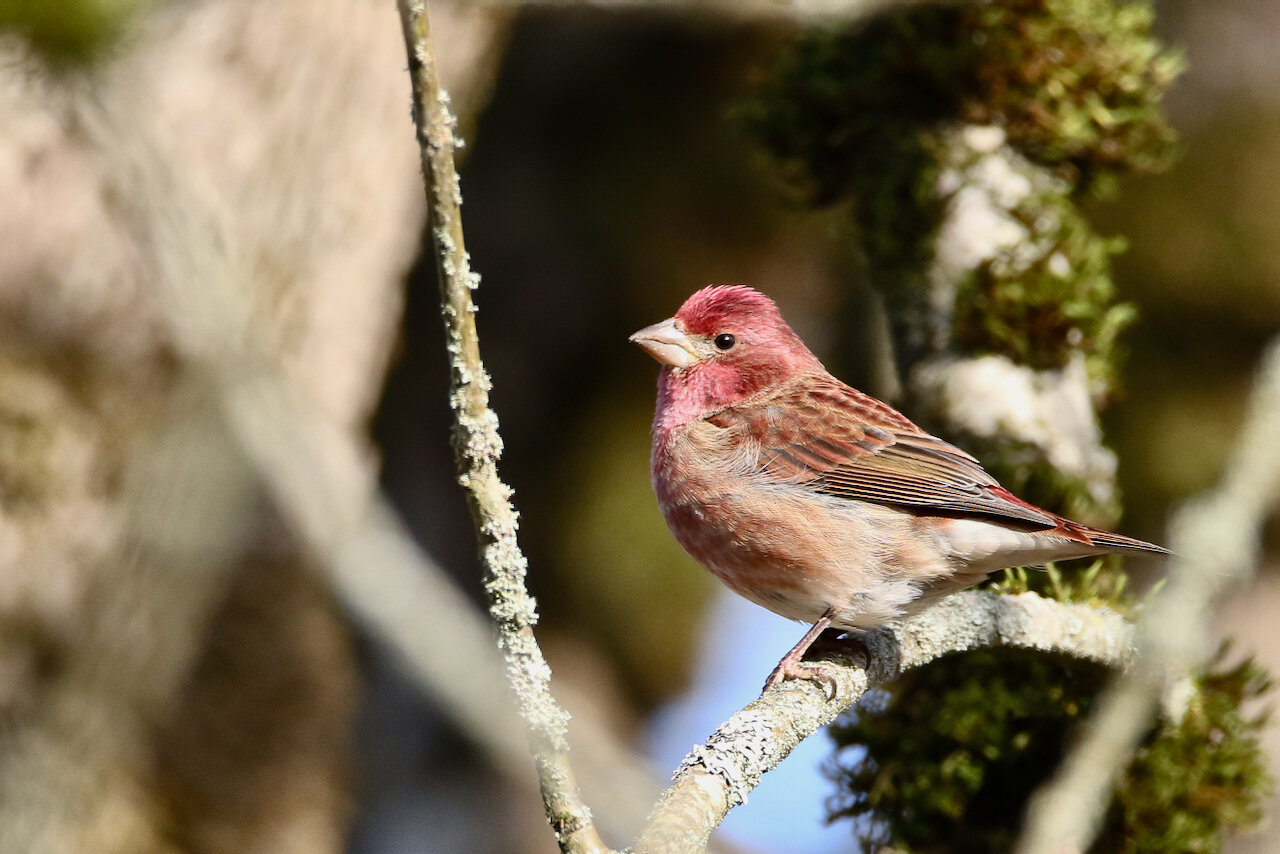
Purple finches are sparrow-sized birds, 5 to 6 inches in length, with a conical bill. They are fairly common throughout Thurston County, occupying forest edges. They’re seed eaters and often visit bird feeders. The males have pinkish red heads and upper breasts, with brown backs and whitish bellies. Females have no red. Both are distinguished by a prominent eye stripe, purple for the male and tan for the female. They are not really purple in color, of course, but that name helps distinguish them from the more common house finch males that have red heads and breast.

There’s other interesting bird news from my house as well. Several years ago, I put up a bird box outside my bathroom window, hoping to have some nesting activity to watch. Until this year there were no takers for the box, but for about two weeks now Bewick’s wrens has been investigating the box and bringing in nesting materials.
Bewick’s wrens build nests in cavities, crevices and on ledges; both sexes build the next, which has a cup lined with feathers, down, soft plant material and even snake skin. Nests typically have three to five eggs, and the adult pair will often raise two broods. They also will fill nearby cavities that they are not using with sticks to discourage other wrens from nesting there; hence, there’s no guarantee that my box will be used this year.

These wrens are also sparrow sized (about 5 inches) but are very different in appearance and behavior from finches and sparrows. They’re very active, fliting though brushy areas seeking insects, their primary food, using their dagger-like bill. They have a brown back and light gray breast and belly, and a prominent white eyebrow stripe. If they stay still long enough to notice, you will see they have black bands with white tips on their tails.
With an assist from the Merlin app, I have been hearing Bewick’s wren song in my area for weeks. The song begins with one to two quick notes followed by a burry trill. They are curious birds and will come near if you make a pishing noise.
Migrating birds are arriving daily now. As Tom Boucher commented for last week’s column, ospreys are arriving from their southern wintering territories, and when they arrive, they almost immediately begin nest building. These large birds like to build stick nests at the top of trees and poles. As I drive around, I try to check out the top of the communication towers looking for piles of sticks that indicate the ospreys are nearby.

All the various swallow species have been here for quite a few weeks now and they will soon start nesting activities. You may notice barn swallows flying under eaves seeking a good ledge to use as a platform for their mud nests. The last swallow species to reach our county is the purple martin. They are arriving now and will immediately begin making territorial claims to nest boxes.
There are such boxes on the pilings of inner East Bay in Olympia. That’s a good place to spot purple martins. They are seven-plus inches in size, the largest of the swallows in Thurston County. The males may appear black but in good light they are an iridescent blue-purple with black wings and tails. Females are a dull dark gray with a whitish breast and belly.
These, and all swallows, are valuable neighbors. They spend their days catching insects, including mosquitoes that might otherwise be disrupting your backyard activities. This value was recognized by Native Americans who hung empty gourds to attract purple martins. The Nisqually Reach Nature Center at Luhr Beach, a great place to see purple martins up-close, has gourd-like nest boxes that imitate this tradition.
In summary, our avian neighbors are getting very active. The Merlin App helps with identification of which species are singing, but that isn’t essential. Just get outside and enjoy the birds welcoming the spring season.
George Walter is environmental program manager at the Nisqually Indian Tribe’s natural resources department; he also has a 45+ year interest in bird watching. He may be reached at george@theJOLTnews.com
Bird photos for this column are provided by Liam Hutcheson, an 18-year-old Olympia area birder and avid photographer.


Comments
No comments on this item Please log in to comment by clicking here