
Thursday, October 22, 2026


The telephone message arrived one evening last week.
“I live right in the middle of the city and there’s an owl hooting outside. What’s going on? It sounds lonely. Is it looking for a mate?”
We in Thurston County are fortunate to have nature all around us. Wherever you live, you are not far from good bird habitat. But owls, and especially the large hooting ones? Yes! I would venture that no one in our county lives more than a mile or so from an owl’s home territory.
Urban areas are popular hunting grounds for owls. Their prey targets include rats and mice, as well as larger night creatures, such as raccoons and opossums.
They don’t always vocalize, however. The American barn owl is a species that is usually very quiet and secretive. There are barn owl breeding pairs nesting in at least one, and possibly several, church bell towers.

Barn owls really don’t build nests. Rather, they create a scrape of materials, and then lay eggs, at least two and sometimes many more, usually at the rate of one every day or two.
The female begins to brood the eggs immediately, and thus the eggs hatch sequentially. When looking into a nest, an observer might see young birds of multiple sizes and development stages. This means that, in times of food shortage, only the older and fitter youngsters survive. Conversely, when food is abundant, many more may survive.
You might see a barn owl flash through the glare of your headlights late at night. They are white, gray and cinnamon, and have a distinctive heart-shaped face. When not out hunting, these owls tend to stay in their nesting roosts, and thus, just like other urban owls, the actual size of their local population is difficult to assess.
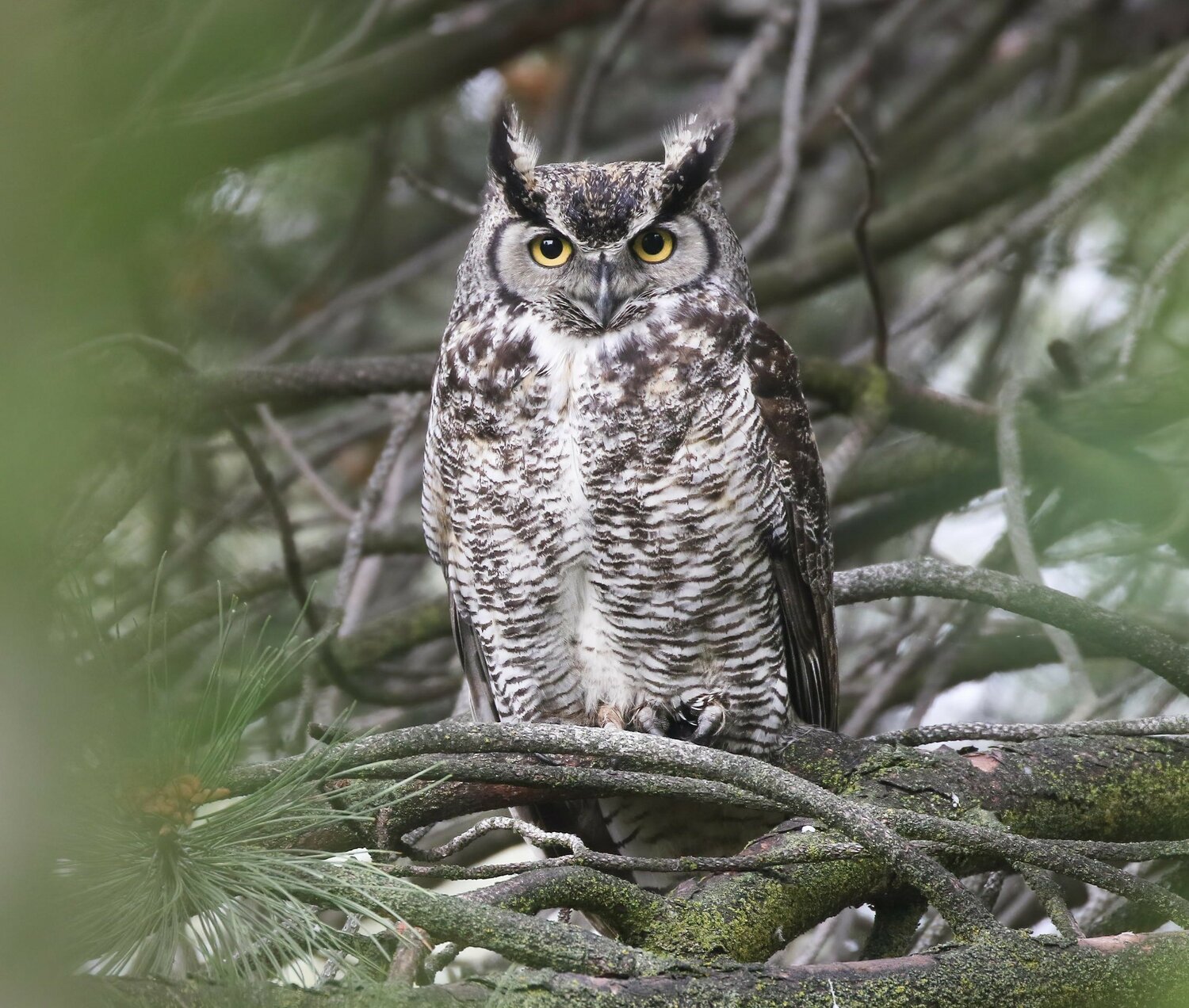
The hooting owls reported are one of two species, the great horned owl or the barred owl. Both these species start loudly hooting in November and may continue through the winter. They are primarily hooting to establish breeding territories, and many times, one can hear the pair of owls calling back and forth.

The hooting calls differ by species and can be told apart fairly easily. The great horn’s hoot is a loud hoo-hoo-hoo-hoo. The barred’s call is a distinctive one that is often transcribed as “who cooks for you?” You can check out these calls on the Merlin app, or at the many websites available that describe these two owl species.
The great horned owl also does not actually build a nest, but often occupies a large nest created by another species — a hawk or crow, for example. Sometimes, they nest in cavities or in the large crotch of a forest tree. They begin nesting early and females may be brooding eggs by the end of December. When you see a stick nest up in a bare tree, give it a look. You might see the horned outline of an owl’s head sticking up from the nest.
Great horns are much larger than the barred owls and may at time prey on barred owls. If fact, the great horned is the dominant avian predator of the night sky. Studies on the remains of prey scattered below these owls’ nests have identified a wide variety of prey, including domestic cats, which are often found in urban areas.
That’s something to keep in mind when you let your cat out to roam for the night. These birds might be encountered almost anywhere, including urban areas, and are sometimes spotted at dusk perching on a roof top or utility pole.
Barred owls much prefer wooded areas. For example, the forested part on the east side of Squaxin Park, Mission Creek Park, LBA Park or Watershed Park. If you have a wooded area near your house, that hooting owl might be a barred owl. These birds usually nest in a natural cavity 20 feet or more up in a tree, but on occasion they have been known to take over stick nests created by other species. Because they are more confined to forested areas, their diet is limited primarily to smaller forest rodents, including flying squirrels.
But they’re not always out in the woods. A few years back, a barred owl perched in a cedar tree in a friend’s urban backyard for several days and was unperturbed by her presence — and by the visits from neighbors who were thrilled to see it.
Regardless of where you live, these three owls are nearby, but usually secretive, neighbors that might, from time to time, make their presence known if you care to listen. They are also sometimes hard to spot while roosting during the day because they blend in so well with their forest backgrounds.
For the weeks around the Christmas holiday, the National Audubon Society, in coordination with local chapters, sponsors its Christmas Bird Count (CBC). The local sponsoring group identifies and maps a 10-mile diameter circle, and then teams of volunteers spend part of a specific day counting the numbers of all bird species encountered on that day.
Our local count is the Olympia CBC, sponsored by the Black Hills Audubon Society. This year the Olympia count day is Sunday, Dec. 14. You can learn more about this event at this link.
One of the better ways to participate is to add your feeder count of birds to the overall count numbers. Simply count the number of birds by species (taking care not to double count return visitors), and then send these numbers and your address to the count compiler. Or you can send them to me, and I will forward them. Your address is important because the overall data is tabulated by subareas with the county circle.
Your contribution to the Christmas Bird Count will help track the changing numbers and the changing territories of birds.
George Walter is environmental program manager at the Nisqually Indian Tribe’s natural resources department; he also has a 40+ year interest in bird watching. He may be reached at george@theJOLTnews.com
Photos for this column are provided by Liam Hutcheson, a 17-year-old Olympia area birder and avid photographer.



Comments
No comments on this item Please log in to comment by clicking here