
Wednesday, October 21, 2026


There are definite limits if you want to go bird watching in mid-winter. The days are short, cold and damp, and most birds are reclusive. The major exceptions are the waterfowl.
Consequently, birders who go out in any weather often focus their attention on waterfowl in winter. They (not me, I’m mostly a fair-weather birder) regularly visit places where waterfowl concentrate. From time to time, they spot rare waterfowl visitors. Regular readers might recall that in December these rarities included a whooper swan.
One of the best sites to spot visiting waterfowl is the south end of Capitol Lake along Deschutes Parkway, just before it passes under Interstate 5. A trail starts there continues along the lake and under the freeway, ultimately ending at other trails associated with Tumwater Historical Park (and, of course, you could start there instead and walk north instead of south).
In the last week, two relatively rare waterfowl visitors have been spotted in this southern lake area. The first is the Eurasian subspecies of the green-winged teal. Green-winged teal are small crow-sized dabbling ducks that feed on vegetation at or near the shoreline. They are named for the green feather patch on their wings. Females are a nondescript mottled brown.
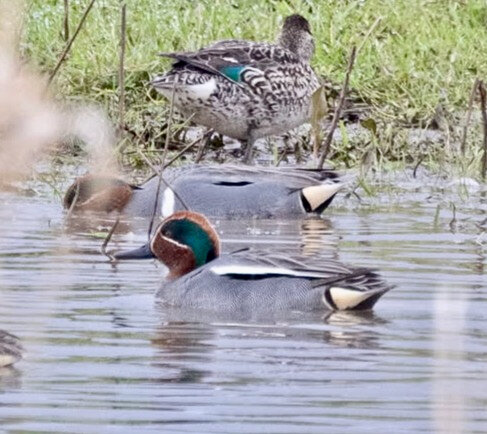
The male, however, is more boldly colored, with a gray body, black and white rump, cinnamon head with a bold green swoop from eye to back of neck. Liam’s photo illustrates the key identification feature for males of the two subspecies. Our common North American green-winged teal has a white vertical stripe at his shoulder; the Eurasian male lacks this vertical stripe but has a horizontal white stripe on his side.
The second uncommon duck seen recently on Capitol Lake are Redhead ducks. In this species it is also the male that carries the bold color — a cinnamon-red head (he’s well-named, right?), black breast and rear, and gray body. His bill is gray with a black tip and his eyes have orange irises.

Females are plain uniform brown and may show a similar gray with black tip bill. (In virtually all the ducks, it’s the guys who generally are more dressed up, all part of their breeding season campaign to be attractive to the women.)
Redheads breed in the interior wetlands of North America. They winter in large numbers in Eastern Washington along rivers but are uncommon to rare in Western Washington. In addition to Capitol Lake, a few have been seen recently in the Nisqually area.
Inner Budd Inlet is also a good winter birding location for waterfowl that prefer saltwater feeding grounds and another rare duck — a female long-tailed duck — has been seen there recently. This species breeds in the far northern Arctic and Puget Sound is at the extreme southern end of its wintering territory. There are always a few long-tailed ducks recorded on Puget Sound Christmas Bird Counts.

These are small diving ducks with unusually small bills, able to reach depths of 200 feet in search of marine invertebrates and small fish. Our Budd Inlet female is brownish with a white head and an obvious smudgy brown cheek patch. Only the males have long tail plumes, and no males have been sighted around here this winter.
A final good location for finding winter waterfowl is the Washington State Department of Natural Resources Woodard Bay Conservation Area, located in northeast Thurston County off Libby Road (see Woodard Bay Natural Resources Conservation Area website). There are numerous ducks and other water birds that winter here and there’s a paved road that leads from the parking area to several overlooks.

If you visit, you might be lucky enough to spot the female black scoter that has been seen off-and-on here since mid-December. Male black scoters are all black, but the female is a brownish with a dark brown cap that contrasts with her whitish face. That contrast is relatively easy to see and is distinctive from any other scoter or other diving duck.
As usual, I recommend that you review the photos in your favorite bird book before seeking any of these unusual winter visitors. They will be much easier to identify if you become familiar with their general appearance before venturing forth with your binoculars.
A reader alerted me that earlier this week she saw 100+ trumpeter swans in a grassy dairy pasture adjacent to I-5 in the Chehalis area. The I-5 freeway passes through many rural areas between Olympia and the Oregon border. Geese and swans like to graze fresh green grass and are apt to be seen in such places anywhere along this I-5 corridor.
George Walter is environmental program manager at the Nisqually Indian Tribe’s natural resources department; he also has a 45+ year interest in bird watching. He may be reached at george@theJOLTnews.com
Photos for this column are provided by Liam Hutcheson, an 18-year-old Olympia area birder and avid photographer.


1 comment on this item Please log in to comment by clicking here
sunshine39
Thank you, George. Your details are always so helpful. Helps me appreciate these beautiful creatures.
Thursday, January 15 Report this